
 |
 |
 |
ENG
THE ISLET OF SAINT MARY
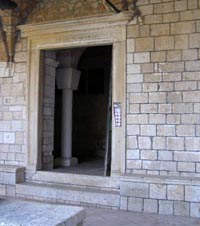
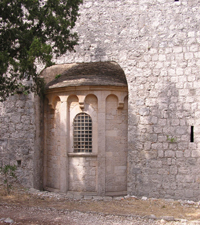
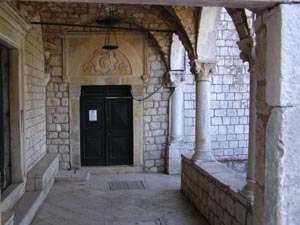
 In the 12th c. island Mljet falls into the power of Neretvan people. King Desa gives the island to the Benedictines from Mt. Cassino on the peninsula of Gargano in Apulia to be their exclusive property. Three Benedictines of Ragusan descent come from Italy and choose the islet in the middle of the Large Lake for their permanent residence. There they build St. Mary's church and a monastery in Romanesque style. Originally, the church and the monastery are not connected. The portal and two windows of the first monastery can be seen in the cloister of the present monastery. In the 12th c. island Mljet falls into the power of Neretvan people. King Desa gives the island to the Benedictines from Mt. Cassino on the peninsula of Gargano in Apulia to be their exclusive property. Three Benedictines of Ragusan descent come from Italy and choose the islet in the middle of the Large Lake for their permanent residence. There they build St. Mary's church and a monastery in Romanesque style. Originally, the church and the monastery are not connected. The portal and two windows of the first monastery can be seen in the cloister of the present monastery.In 1345 the abbot of the Marian monastery makes a contract under which the monastery remains the owner of one third of the island, while in its other part the Universia (municipality) is founded. Every year the Universia of Mljet has to pay the monastery 300 hyperpers, donate one han per household for the Festival of St. Blaise, and provide 2 shepherds at the discretion of themonastery for the whole year. This contract is immediately followed by another document, the Statute of Mljet, and from then on three kinds of books are kept in the Mljet's office: Documenti, Vendete and Testamenti. Island Mljet definitely goes to the Dubrovnik Republic in 1410. In the 16th c. the church and the monastery merged into one, because the church got a Renaissance vestibule and porch, while the monastery became a spacious Renaissance building with cellars, ground floor and first floor. The defence tower and wall were probably added in the 17th c. for the protection from Turkish pirates. Although the structure has the appearance of a Renaissance summerhouse, actually, it was also a fortification, completely closed, with the apse of the church built into the defence wall. During the conservation works it was opened so that the architectural structure of the Romanesque church of St. Mary could be revealed. In the very front of the building there was a Renaissance porch serving as shelter for boats. The building was once connected with the sea because one could gain access to the cellars from the Large Lake using a boat and passing under the porch. As poet Ignjat Đurđević describes, one could fish from the monastery windows. In the 18th c. the church underwent some changes-the chapels were added, so that the floor plan of the church got the form of a cross. Besides, a Baroque balcony was reconstructed, which has been preserved till today. This monastery was the seat of the Mljet Congregation (Congregatio Melitensem or Melitanam) from the day of its establishment at the beginning of the 16th century. The first chairman was abbot and poet Mavro Vetranović Čavčić, who was summoned from Rome to lead the Congregation and revive its monasteries. The Congregation comprised four man's monasteries in the area of the Dubrovnik Republic (St. Michael's on Šipan, St. Andreas's on the open sea, St. Jakob's near Dubrovnik and St. Mary's on Mljet). This step was aimed at subjecting the monasteries to the direct power of Rome in order to avoid the Venetian influence on the Dubrovnik Republic. Later, the seat of the Congregation was moved to St. Jakob's monastery near Dubrovnik. One of the abbots was poet Ignjat Đurđević from a distinguished patrician family of Dubrovnik. He wrote a satirical epic “Tears of Marunko's” in which some geographical names from Mljet are mentioned, which shows that the characters from the epic had ties with the island. The Congregation was definitely abolished in 1808, when Napoleon's army occupied Dubrovnik. Then the big library and archives were raided and burned down, so that some data are lost. Only a small fragment has been saved in the Franciscan library in Dubrovnik. The Benedictines were retired and moved to the Franciscan monastery in Dubrovnik, while the building had changed the owners. The Statute of Mljet was taken to Vienna, and the monastery on Mljet served as the headquarters of the Austrian Forest Administration till WWI. The building was then given to the Dubrovnik Bishopric. After the WWII it was taken away from Bishopric and stood empty till 1961, when it was converted to a hotel that operated till the beginning of the Patriotic War in 1991. At the end of the islet of St. Mary there are a few more structures, but their purpose and age are unknow. The whole islet is in fact an olive grove with paths for strolling and stone benches for resting. |
|||
|
Ulaz u crkvu |
Trijem ispred crkve i samostana | ||
 |
 |
 |
|
made by Ksenija BanovacCopyright 2008. Suveniri Katja